
2026 — Q1
index
26Q1




PT—00/
07
Playtesting
should be free
The incumbent defense companies are unable to build the technology we need to reaffirm our technological lead.
We need a new breed of defense technology companies to reboot the arsenal of democracy.
PT—00/
07
Rebooting the Arsenal of Democracy
It is time to recapture the spirit of innovation
INTRO

INTRODUCTION
If you have followed world events for the last decade, you have felt something changing. The 20th century is well behind us, and with it the sense that America and its allied democracies are the undisputed leaders of the world. World War II – the last major war that America and its allies can truly be said to have won – feels awfully long ago.
The most glaring herald of our decline is in our military’s technology. Once upon a time, the armed services of the United States, United Kingdom, and their partners across the world were envied for their science fiction technology. Today, they are equipped with tools decades behind what you or I use every day. Software has, to paraphrase Marc Andreessen, tried to eat the world, but with the battlefield it found a meal too ungainly to digest.
Despite spending more money than ever on defense, our military technology stays the same. There is more AI in a Tesla than in any U.S. military vehicle; better computer vision in your Snapchat app than in any system the Department of Defense owns; and, until 2019, the United States’ nuclear arsenal operated off floppy disks.
The absence of a crisis made us complacent. In the aftermath of the Cold War, America and its allies felt invincible. Former Soviet states appeared to be liberalizing. China’s economy was growing, and most modernization theorists believed that the Chinese Communist Party would move inexorably toward open democracy. It was the end of history – the triumph of Western ideals and a new age of American-led world order.
Until it wasn’t. Instead of acquiescing, our competitors seized the moment. China and Russia spent two decades harnessing our most powerful weapon – innovation – and built advanced weapon systems designed to neutralize and surpass our own.
The results are sobering: today, in almost every wargame the United States Department of Defense models against China, China wins.
All too quickly, we have reached the point where, in the words of General C.Q. Brown, “We must accelerate change, or lose.”
SHAEF-LONDON, 1944
SHAEF-LONDON, 1944
SHAEF-LONDON, 1944
SHAEF-LONDON, 1944
If you have followed world events for the last decade, you have felt something changing. The 20th century is well behind us, and with it the sense that America and its allied democracies are the undisputed leaders of the world. World War II – the last major war that America and its allies can truly be said to have won – feels awfully long ago.
The most glaring herald of our decline is in our military’s technology. Once upon a time, the armed services of the United States, United Kingdom, and their partners across the world were envied for their science fiction technology. Today, they are equipped with tools decades behind what you or I use every day. Software has, to paraphrase Marc Andreessen, tried to eat the world, but with the battlefield it found a meal too ungainly to digest.
Despite spending more money than ever on defense, our military technology stays the same. There is more AI in a Tesla than in any U.S. military vehicle; better computer vision in your Snapchat app than in any system the Department of Defense owns; and, until 2019, the United States’ nuclear arsenal operated off floppy disks.
The absence of a crisis made us complacent. In the aftermath of the Cold War, America and its allies felt invincible. Former Soviet states appeared to be liberalizing. China’s economy was growing, and most modernization theorists believed that the Chinese Communist Party would move inexorably toward open democracy. It was the end of history – the triumph of Western ideals and a new age of American-led world order.
Until it wasn’t. Instead of acquiescing, our competitors seized the moment. China and Russia spent two decades harnessing our most powerful weapon – innovation – and built advanced weapon systems designed to neutralize and surpass our own.
The results are sobering: today, in almost every wargame the United States Department of Defense models against China, China wins.
All too quickly, we have reached the point where, in the words of General C.Q. Brown, “We must accelerate change, or lose.”

PT—00/
07
Rebooting the Arsenal of Democracy
PT—1
HOW DID WE GET HERE?
HOW DID WE GET HERE?
LEARN MORE WITH US
If you have followed world events for the last decade, you have felt something changing. The 20th century is well behind us, and with it the sense that America and its allied democracies are the undisputed leaders of the world. World War II – the last major war that America and its allies can truly be said to have won – feels awfully long ago.
The most glaring herald of our decline is in our military’s technology. Once upon a time, the armed services of the United States, United Kingdom, and their partners across the world were envied for their science fiction technology. Today, they are equipped with tools decades behind what you or I use every day. Software has, to paraphrase Marc Andreessen, tried to eat the world, but with the battlefield it found a meal too ungainly to digest.
Despite spending more money than ever on defense, our military technology stays the same. There is more AI in a Tesla than in any U.S. military vehicle; better computer vision in your Snapchat app than in any system the Department of Defense owns; and, until 2019, the United States’ nuclear arsenal operated off floppy disks.
The absence of a crisis made us complacent. In the aftermath of the Cold War, America and its allies felt invincible. Former Soviet states appeared to be liberalizing. China’s economy was growing, and most modernization theorists believed that the Chinese Communist Party would move inexorably toward open democracy. It was the end of history – the triumph of Western ideals and a new age of American-led world order.
Until it wasn’t. Instead of acquiescing, our competitors seized the moment. China and Russia spent two decades harnessing our most powerful weapon – innovation – and built advanced weapon systems designed to neutralize and surpass our own.
The results are sobering: today, in almost every wargame the United States Department of Defense models against China, China wins.
All too quickly, we have reached the point where, in the words of General C.Q. Brown, “We must accelerate change, or lose.”
SHAEF-LONDON, 1944
SHAEF-LONDON, 1944
SHAEF-LONDON, 1944
SHAEF-LONDON, 1944
In his eponymous memoir about the group, former Lockheed Skunk Works director Ben Rich tells two stories. One, for which he is best remembered, is a tale of aspiration and ingenuity. Alongside his iconoclastic predecessor, Kelly Johnson, Rich and his team of “skunks” designed and built vehicles that changed how the United States waged war and gathered intelligence: the U-2 spy plane, the SR-71 Blackbird, and the F-117 Nighthawk. Lockheed’s incredible record of innovation in the national interest is defense industry mythology; Rich’s memoir is practically mandated reading for patriotic engineers. The second story Rich tells, however, is less optimistic. Writing in 1994, Rich warns of a creeping decline among the major defense companies. “In my forty years at Lockheed,” he wrote, “I worked on twenty-seven different airplanes. Today’s young engineer will be lucky to build even one.” Not only were new things rarely being built, Rich observed, but the costs of even trying to do so had skyrocketed. “The development costs of fighters have increased by a factor of 100 since the 1950s, and unit procurement costs have risen 11 percent every year since 1963,” Rich despaired. “Small wonder, then, that there were only seven new airplanes in the 1980s, compared to forty-nine in the 1950s.” Rich’s first story is history; his second is yet to conclude. The United States has not fielded a new bomber plane since the end of the Cold War. The F-35, one of the few new major systems the military is fielding, has become a byword for extravagance, currently estimated to cost taxpayers $1.6 trillion. And instead of attracting new entrants to fill the gaps, the Pentagon lost a staggering 20,500 suppliers from 2000 to 2018.
SHAEF-LONDON, 1944
SHAEF-LONDON, 1944

SHAEF-LONDON, 1944
SHAEF-LONDON, 1944
SHAEF-LONDON, 1944
+SHAEF-LONDON, 1944
When former Lockheed CEO Norm Augustine wrote that “In the year 2054, the entire defense budget will purchase just one aircraft,” he was joking – but not by much.
How did we get here? Understanding our present circumstances means understanding the history the led us here. We do not have to delve far into the past – World War II and the years immediately following were a golden age of military innovation.
"It was the civilian scientists, not the military engineers, who had been the technological innovators during the war. ‘They are the ones who made the breakthroughs,’ [General Arnold] said. He predicted that those breakthroughs—in radar, in jet propulsion, in rocketry, in nuclear weapons—would prove to be the catalysts for further innovation that would radically alter the nature of war. The First World War had been decided by brawn, he said, the Second by logistics. ‘The Third World War will be different. It will be won by brains.’"
— Neil Sheehan, A Fiery Peace in a Cold War
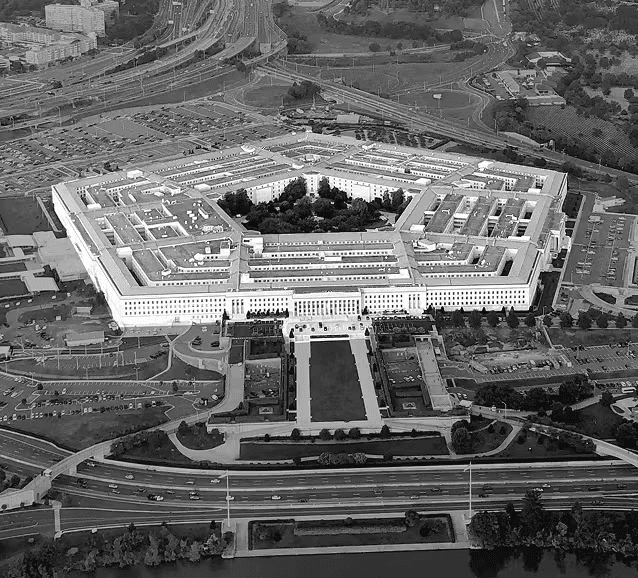
BUILD TIME: 16 MONTHS
OPERATING LIKE A STARTUP
It can be difficult to imagine the Department of Defense, which today employs nearly 3 million Americans, moving quickly. But last century, it innovated at a speed that puts modern Silicon Valley startups to shame: the Pentagon was built in only 16 months (1941-1943), the Manhattan Project ran for just over 3 years (1942-1946), and the Apollo Program put a man on the moon in under a decade (1961-1969). In the 1950s alone, the United States built five generations of fighter jets, three generations of manned bombers, two classes of aircraft carriers, submarine-launched ballistic missiles, and nuclear-powered attack submarines. Perhaps it should not surprise us that the government worked at the pace of a Silicon Valley startup, given that World War II and Cold War military research and development kickstarted Silicon Valley in the first place. Fred Terman, the “father of Silicon Valley,” had left Stanford in World War II to run the Harvard Radio Research Laboratory, the Department of Defense’s premiere electronic warfare lab. When he returned to Stanford after the war, he brought a wealth of government connections and influence with him. By 1947, the DoD provided half of Stanford School of Engineering’s budget. Federal government spending on science and engineering, much of it concentrated in Silicon Valley, continued to balloon – in 1960, the DoD accounted for 36% of all research and development in the world. The DoD’s investments didn’t just benefit the military, though. Decades of military research sowed the seeds of prosperity in the consumer and enterprise sectors. The French media mogul and politician Jean-Jacques Servan-Schreiber, writing in 1967, marveled at the United States’ pace of innovation, predicting that “In thirty years America will be a post-industrial society… There will be only four work days a week of seven hours per day.” The commercial sector continued to advance – perhaps not as quickly as Servan-Schreiber imagined, but quickly enough for America to remain the most innovative country in the world. But, starting in the 1960s and intensifying through the 70s and 80s, the pace of military innovation began to slow, while costs grew. In 1955, it had become clear that the pace of defense spending was unsustainable: the federal government was spending more on defense than everything else combined. Congress knew something had to change. Robert S. McNamara, a wunderkind World War II veteran with a sterling reputation for administrative efficiency at Ford Motor Company, was the man for the job.
DEVELOPER
SHAEF-LONDON, 1944
SHAEF-LONDON, 1944
In the early 1960s, under the direction of then Secretary of Defense McNamara, the Department of Defense instituted a labyrinth of new rules for acquiring military systems. McNamara was not merely reducing spending: his experience at Ford led him to believe that wholesale reform was needed to reshape how the government bought technology. He revamped acquisitions to emphasize efficiency, the elimination of waste, and predictability. The Planning, Programming, and Budgeting System (PPBS, later changed to PPBE for “Execution”) process that he implemented is arguably the single most influential defense reform ever enacted, indelibly altering the incentives and business models of the major defense contractors. Competition with the Soviet Union shaped McNamara’s actions – but perhaps not as modern observers would expect. Whereas today senior DoD leaders have rightly sounded the alarm on China’s ability to compete technologically with the West, McNamara did not believe the Soviet Union capable of out-innovating the United States. In the account of Brigadier General James M. Roherty, McNamara viewed the competition against the Soviet Union in terms of “quantifiables,” believing that “a relative stability characterized weapons technology in the 1960s… that ‘technological surprise’ [was] not a threat to national security and that major breakthroughs [were] not to be expected.” The primary focus of McNamara’s reforms was hence not innovation but cost control. He believed that, by and large, the United States already had the technology it needed to win the Cold War, and that the only problem was making sure that we didn’t spend ourselves into oblivion. The headline-grabbing arms races against the Soviet Union – the “missile gap,” the “bomber gap” – reflected differences in quantity, not quality, of military systems. McNamara’s reforms were not wrong: they were built for a specific era with specific characteristics. Those characteristics included the federal government conducting the vast majority of research and development, rather than private companies; the overwhelming importance of large, capital-intensive, “exquisite” military systems like tanks and battleships; a predictability in the adversary’s (the Soviet Union’s) rate of technological progress; and the existence of relatively few companies able to muster the capital and expertise to build military technology. All of those things have, to varying degrees, changed, but our system for buying technology has not. As a result, the large defense companies have learned to operate in highly idiosyncratic ways, unlike major companies in any other industry:
SHAEF-LONDON, 1944
SHAEF-LONDON, 1944
SHAEF-LONDON, 1944
+SHAEF-LONDON, 1944
If you have followed world events for the last decade, you have felt something changing. The 20th century is well behind us, and with it the sense that America and its allied democracies are the undisputed leaders of the world. World War II – the last major war that America and its allies can truly be said to have won – feels awfully long ago.
The most glaring herald of our decline is in our military’s technology. Once upon a time, the armed services of the United States, United Kingdom, and their partners across the world were envied for their science fiction technology. Today, they are equipped with tools decades behind what you or I use every day. Software has, to paraphrase Marc Andreessen, tried to eat the world, but with the battlefield it found a meal too ungainly to digest.
Despite spending more money than ever on defense, our military technology stays the same. There is more AI in a Tesla than in any U.S. military vehicle; better computer vision in your Snapchat app than in any system the Department of Defense owns; and, until 2019, the United States’ nuclear arsenal operated off floppy disks.
The absence of a crisis made us complacent. In the aftermath of the Cold War, America and its allies felt invincible. Former Soviet states appeared to be liberalizing. China’s economy was growing, and most modernization theorists believed that the Chinese Communist Party would move inexorably toward open democracy. It was the end of history – the triumph of Western ideals and a new age of American-led world order.
Until it wasn’t. Instead of acquiescing, our competitors seized the moment. China and Russia spent two decades harnessing our most powerful weapon – innovation – and built advanced weapon systems designed to neutralize and surpass our own.
The results are sobering: today, in almost every wargame the United States Department of Defense models against China, China wins.
All too quickly, we have reached the point where, in the words of General C.Q. Brown, “We must accelerate change, or lose.”
PT—00/
07
Rebooting the Arsenal of Democracy
PT—3
THE DEFENESE INDUSTRY
THE DEFENSE INDUSTRY TODAY
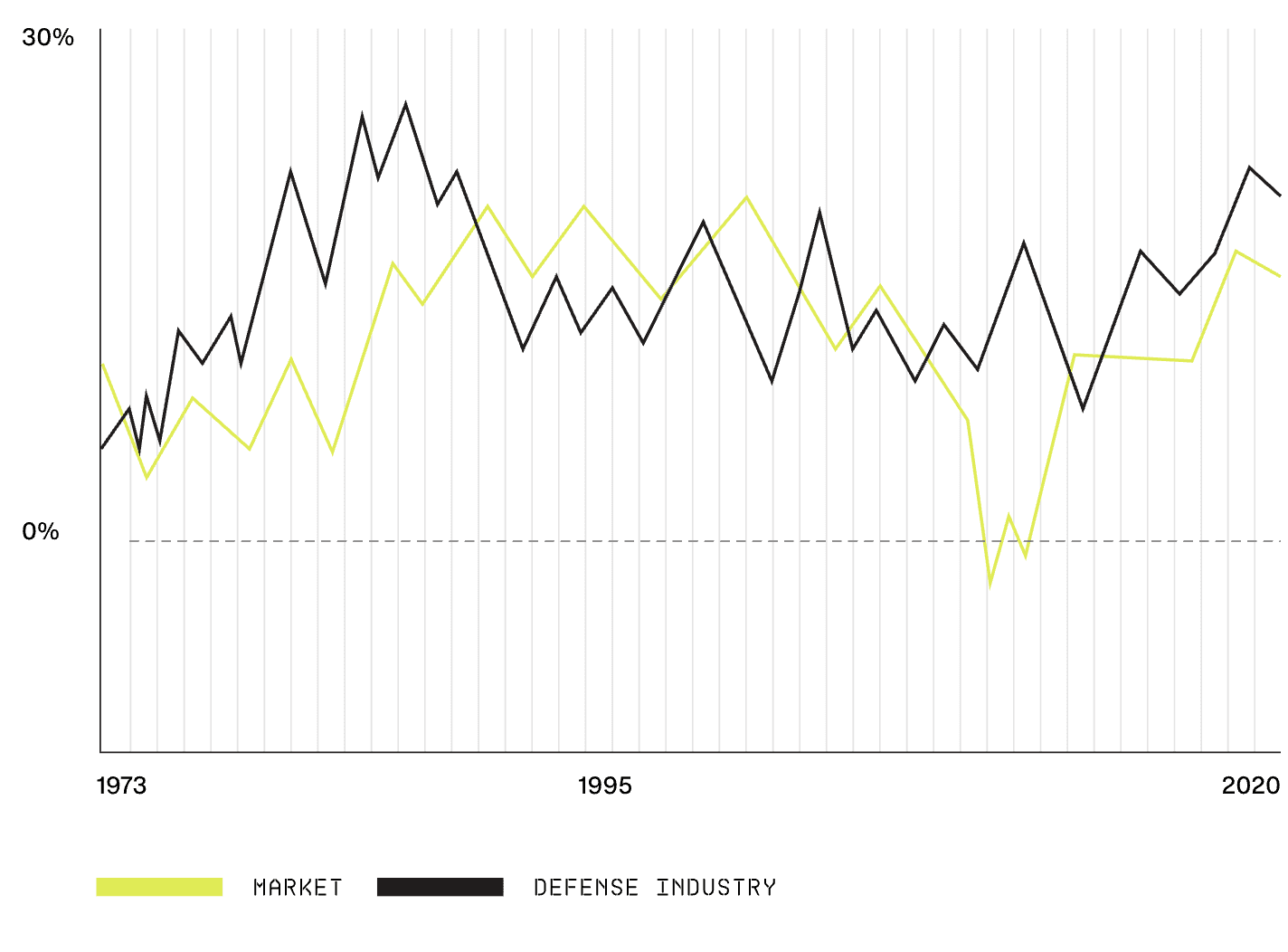
One remarkable statistic tells a damning story about the modern defense sector: since 1963, the defense industry has never suffered a negative ten-year period. Is this because defense companies have built an unprecedented succession of valuable products? Far from it. On a long enough time horizon, defense companies are simply not punished for failure (and, indeed, the horizon is not all that long). Individual companies may receive a slap on the wrist for particularly egregious missteps, but by and large the government accepts that, frustrating as it may be, slow timelines, minimal innovation, and swelling costs are “the way things are.” Part of the reason that the large defense companies keep getting away with underperformance is that they face little competition. In 1993, the Cold War fading into memory, then Deputy Secretary of Defense Bill Perry sat down with the CEOs of the major defense firms at what came to be known as “the last supper.” Perry warned them that substantial cuts to the defense budget were coming and that many of their companies would not be able to survive. Put simply, he said, “We expect defense companies to go out of business. We will stand by and watch it happen.” This precipitated a flurry of mergers and acquisitions. Perry attempted to counterbalance the impact of consolidation by lowering the barriers to entry into the defense industry. He discouraged the use of onerous military specifications (“milspecs”) for new systems except as a “last resort” and championed 1994’s Federal Acquisitions Streamlining Act (FASA), which mandated the use of commercial, off-the-shelf alternatives over bespoke new technology. He also encouraged program managers in the DoD to “take more risks” and bet on new technology and new companies. Many of these changes, however, were not enforced. Both SpaceX and Palantir were forced to sue their largest customers for a failure to adhere to Perry’s rules, while a RAND corporation study from the early 2000s found that program managers had neither the incentives nor capacity to make meaningful bets on new companies and technology. The result is an ageing, top-heavy industry that moves slowly because nobody is chasing it. The ten largest defense companies, all of which were founded decades ago, account for upwards of 80% of the industry’s revenue. Nearly two thirds of major weapons systems contracts in the United States have just one bidder. Shareholders buy defense stocks for their stability, their predictability. These companies move slowly and break as little as possible. Most engineers, understandably, do not wish to work on national security under these conditions. Engineers want to see their code deployed, their robots in motion, their products out in the world making an impact. Working slowly on antiquated technology that may never be deployed is far from an engineer’s dream. And so the companies once staffed with some of the greatest engineering minds in the Western world now struggle to attract graduates from top engineering programs.

PT—00/
07
Rebooting the Arsenal of Democracy
PT—1